
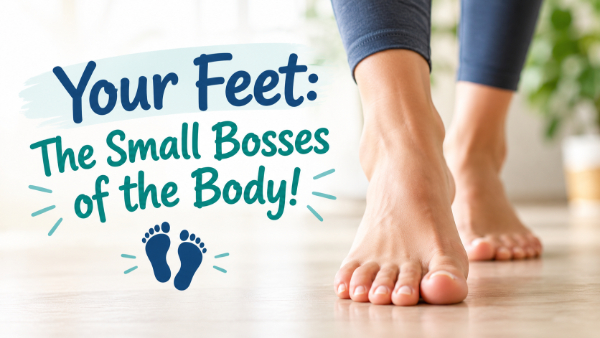
 Your feet are funny little things. They spend all day at the bottom of your body, squeezed into shoes, carrying you around, and rarely getting the credit they deserve. But make no mistake — your feet are the foundation of your entire body’s stability.
Think of your body as a chain reaction. Your feet affect your ankles, your ankles influence your knees, your knees affect your hips, your hips influence your back, and the back has a conversation with your shoulders, neck, and even your head.
In other words, when your feet get out of line, the rest of your body may start playing the Hokey Pokey — compensating, shifting, and trying to keep everything upright!
And what a remarkable foundation they are. Each foot contains 26 bones, 33 joints, and more than 100 muscles, tendons, and ligaments working together in a remarkably coordinated system. The feet and ankles move through three main planes of motion, with movement occurring around three principal axes. That’s a lot of engineering packed into something that fits inside a shoe!
Your feet are not just meant to carry you around. They’re designed to balance you, propel you forward, absorb shock, and adapt to uneven surfaces. They are your body’s very own suspension system — no mechanic required!
But here’s the catch: just like the rest of your body, feet benefit from exercise and training. Strengthening the small muscles, improving mobility, practicing balance, and training the ankles can help your feet function better. And with appropriate exercise, they may even look better, too — stronger arches, more mobile toes, and healthier-looking feet.
Then there’s footwear. Oh, the shoes! We choose them for color, style, and how fabulous they make us look. Sometimes we even buy them because they look comfortable, which is not always the same thing as being comfortable!
The right shoes can support your activities, provide adequate room for your toes, and help your feet function comfortably. The wrong shoes can create pressure, restrict movement, and contribute to a variety of foot problems.
So, the next time you look at your feet, remember: they’re not merely the things at the end of your legs. They’re the beginning of a whole-body balancing act.
Take care of your feet, train them, choose your shoes wisely, and your ankles, knees, hips, back, shoulders, neck, and head may all thank you.
After all, when your foundation is happy, the whole building has a better chance of standing tall!
And if your feet could talk, they’d probably have just one request:
“Please stop blaming your back for everything. Have you looked at your shoes lately?”